

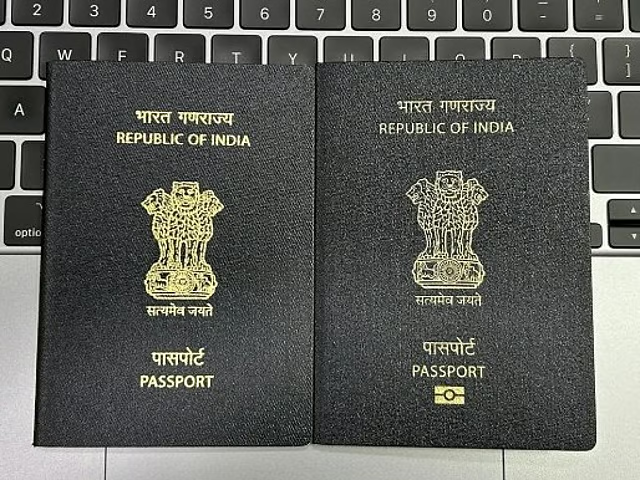
India has officially begun the phased rollout of chip-enabled e-passports, marking a significant upgrade in travel documentation for its citizens. This move is part of the upgraded Passport Seva Programme (PSP) 2.0 and aims to bring Indian passports in line with international security standards, as mandated by the International Civil Aviation Organization (ICAO).
Key Features and Benefits
The new e-passport is a hybrid document, featuring both a traditional paper booklet and an embedded Radio Frequency Identification (RFID) chip within the cover, identifiable by a small gold symbol.
- Enhanced Security: The microchip securely stores the holder’s personal and biometric information (including a digital photograph, fingerprints, and demographic details). This data is protected by a Public Key Infrastructure (PKI) solution, making it highly secure against tampering, forgery, and identity theft. Any attempt to alter the chip will render the passport unusable for authentication.
- Faster Immigration: The chip allows for quicker and more secure verification through automated e-gates at international airports, significantly reducing wait times at immigration counters.
- Global Acceptance: By complying with ICAO standards, the Indian e-passport is globally accepted and trusted by border control agencies worldwide.
- Made in India: The biometric passports are produced domestically at the India Security Press in Nashik, ensuring stringent data security and supporting the “Make in India” initiative.
Rollout Status and Application
The rollout of e-passports began in a pilot phase in April 2024 and is being expanded across the country. As of recent updates, the issuance has commenced in several major cities like Chennai, Nagpur, Hyderabad, Jaipur, and others, with the government working towards a nationwide implementation across all 37 Passport Offices, their 93 Passport Seva Kendras (PSKs), and 450 Post Office Passport Seva Kendras (POPSKs).
Mandatory Replacement:
-
Existing Valid Passports are still valid. Citizens who hold a valid traditional passport do not need to replace it immediately. It will remain valid until its original expiry date.
- New Applicants and Renewals: E-passports are being issued by default to applicants applying for a fresh passport or re-issue in the technically enabled Passport Offices.
How to Apply:
The process for applying for an e-passport is the same as for a regular passport:
- Online Application: Register and log in to the official Passport Seva Portal (www.passportindia.gov.in).
- Fill and Submit: Fill out the application form for ‘Fresh Passport’ or ‘Re-issue of Passport’.
- Pay and Book Appointment: Pay the required fee online and schedule an appointment at your nearest Passport Seva Kendra (PSK) or Post Office Passport Seva Kendra (POPSK).
- Visit PSK: Visit the scheduled centre with your original documents for verification and biometric enrolment (fingerprints and photograph).
This digital upgrade is set to enhance the travel experience for millions of Indian citizens by ensuring smoother, quicker, and more secure international journeys.
Required Documents for Indian E-Passport Application
1. Proof of Present Address (Any one of the following)
The document must be in the applicant’s name (or parent/spouse’s name for certain cases like minors/homemakers).
- Aadhaar Card or e-Aadhaar (front and back clearly showing the address).
- Voter ID Card (Election Photo Identity Card – EPIC).
- Utility Bills (Water, Electricity, Gas, or Landline Telephone) – should be recent (last 3 months).
- Bank/Post Office Passbook with the applicant’s photo (attested and with the latest transaction updated).
- Valid Rent Agreement (must be registered/notarized).
- Spouse’s Passport Copy (if the address matches and includes family details).
- Income Tax Assessment Order.
2. Proof of Date of Birth (DOB) (Any one of the following)
- Birth Certificate (BC) issued by a Municipal Authority or the Registrar of Births and Deaths.
- School Leaving Certificate/Transfer Certificate (TC) or Matriculation Certificate from the school last attended/recognized educational board.
- PAN Card issued by the Income Tax Department with the DOB of the applicant.
- Aadhaar Card/E-Aadhaar with the DOB of the applicant.
- Driving License (with the DOB of the applicant).
- Election Photo Identity Card (EPIC) with the DOB of the applicant.
3. For Re-issue Applications (Renewal, Lost/Damaged, Change in Particulars)
You must submit the following in addition to the mandatory Proof of Address and DOB:
- Original Old Passport (and self-attested copies of the first two and last two pages, including the ECR/Non-ECR page and the page of observation).
| Reason for Re-issue | Additional Documents Required (Examples) |
| Validity Expired/Exhaustion of Pages | Original Old Passport |
| Lost or Stolen Passport | Police Report (FIR) and Annexure ‘F’ Affidavit. |
| Change in Name (e.g., after marriage/divorce) | Original Marriage Certificate or Annexure ‘J’ (Joint Declaration) or Divorce Decree. |
4. Mandatory Annexures/Affidavits (If Applicable)
You must fill out and submit the relevant Annexure, which can be downloaded from the official Passport Seva portal.
- Annexure ‘E’: Mandatory Self-Declaration to be submitted by ALL applicants.
- Annexure ‘D’: Declaration by parents/guardian for a Minor applicant.
- Annexure ‘G’ or ‘H’: For Government Servants (No Objection Certificate or Prior Intimation Letter).
Important Note: The final list of required documents depends on your specific category (Normal/Tatkaal, Fresh/Re-issue, Minor, Government Servant, etc.). It is highly recommended to use the Document Advisor on the official Passport Seva website before your appointment for a definitive checklist.