

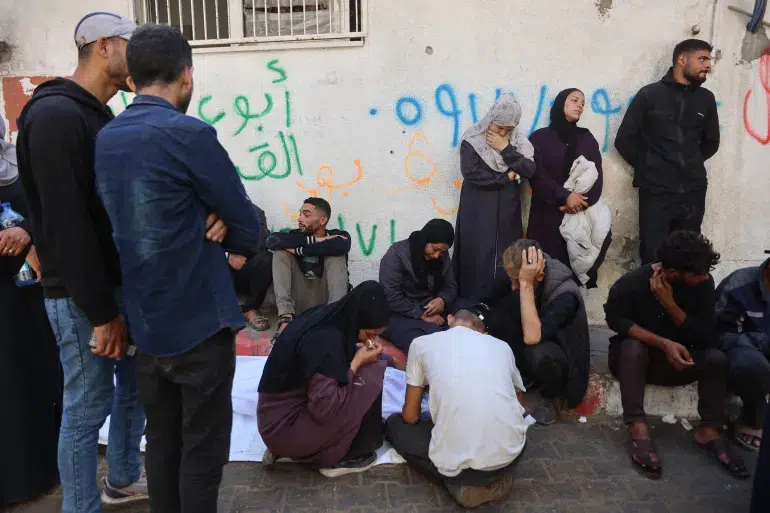
GAZA CITY / WASHINGTON D.C. – A US-brokered ceasefire in the Gaza Strip faced its most serious challenge to date on Wednesday after Israeli overnight airstrikes killed at least 104 Palestinians, including 46 children, according to health officials in the enclave. The massive loss of life followed an exchange of fire that resulted in the death of an Israeli soldier, prompting a swift and powerful military response from Jerusalem.
Despite the deadliest escalation since the truce was enacted earlier this month, US President Donald Trump insisted on Wednesday that the peace deal was not at risk.
Overnight Strikes Shatter Calm
The Palestinian Ministry of Health in Gaza confirmed the mounting civilian casualty figures, reporting that an additional 253 people were wounded in strikes that targeted areas across the territory, including the cities of Khan Younis, Deir al-Balah, and Gaza City. Hospital directors described scenes of chaos, with multiple facilities receiving dozens of bodies, a significant number of whom were women and children.
The Israel Defense Forces (IDF) stated that the strikes were a direct response to a violation of the ceasefire, following an incident on Tuesday in which an Israeli soldier, identified as Master Sgt. Yona Efraim Feldbaum, 37, was killed by “enemy fire” targeting his vehicle in Rafah.
Prime Minister Benjamin Netanyahu’s office ordered “powerful strikes” on Gaza, accusing the militant group Hamas of violating the fragile US-brokered agreement. The IDF later said it had completed its operations, striking what it called “terror targets and terrorists holding command positions” and affirmed that it had begun the “renewed enforcement of the ceasefire.”
Hamas, meanwhile, denied responsibility for the gunfire in Rafah and vehemently accused Israel of carrying out a “blatant violation of the ceasefire deal.”
President Trump Defends Israeli Response
Speaking to reporters aboard Air Force One on Wednesday, US President Donald Trump defended Israel’s retaliatory strikes while maintaining unwavering confidence in the durability of the truce.
“As I understand it, they took out an Israeli soldier,” Trump said, referring to the incident in Rafah. “So the Israelis hit back and they should hit back. When that happens, they should hit back,” he asserted.
Crucially, the President downplayed the impact of the overnight violence on the broader diplomatic process.
“Nothing is going to jeopardize” the ceasefire, Trump declared. “You have to understand Hamas is a very small part of peace in the Middle East, and they have to behave. If they are good, they are going to be happy, and if they are not good, they are going to be terminated, their lives will be terminated.”
The President’s comments underscore the significant pressure being placed on Hamas to adhere to the terms of the US-backed agreement, which was intended to halt the conflict and move toward a phased reconstruction of Gaza and an eventual disarmament.
Truce on a Knife Edge
The current ceasefire, which came into effect earlier this month as the first phase of a broader peace plan, has been repeatedly strained by mutual accusations of violations, most recently centering on the return of the bodies of deceased Israeli hostages. Israel has accused Hamas of attempting to mislead negotiators by returning partial remains of a previously recovered captive, a claim Hamas denies, citing difficulties in locating remains amid Gaza’s widespread destruction.
The new escalation in hostilities—the deadliest breach since the agreement began—places an enormous burden on international mediators, particularly Egypt and Qatar, to restore full compliance and prevent the fragile truce from collapsing entirely. The continued violence highlights the deep chasm between the parties and the tenuous nature of the US-led peace efforts.

Timeline of Events Leading to the Strikes
- Ceasefire in Effect: A US-brokered ceasefire between Israel and Hamas had been in place since October 10, 2025. This truce included a clause for Hamas to return the remains of Israeli hostages.
- Hostage Remains Handover/Dispute: The process of handing over the remains of deceased hostages was a point of friction.
- Tuesday Evening, October 28, 2025: Hamas turned over what Israel described as “body parts” of a hostage whose remains were recovered two years prior, a move that reportedly enraged Israelis.
- Israel accused Hamas of violating the ceasefire by delaying the full return of the remains of all hostages. Hamas denied this and later delayed a scheduled handover, citing what it called Israeli violations.
- Alleged Ceasefire Violation and Israeli Response:
- Tuesday Evening, October 28, 2025: A firefight reportedly occurred between Palestinian militants and Israeli troops, resulting in the death of an Israeli soldier. Hamas denied responsibility for the gun attack.
- Late Tuesday Evening/Overnight: Israeli Prime Minister Benjamin Netanyahu ordered “powerful strikes” on Gaza, calling an emergency meeting and accusing Hamas of violating the ceasefire.
- Overnight Strikes and Casualties:
- Tuesday Night/Wednesday Morning, October 29, 2025: Israeli airstrikes across Gaza reportedly killed at least 104 Palestinians, including at least 35 children, and injured 200 people. Gaza’s civil defense agency called it the deadliest day since the truce began and a “clear and flagrant violation.” Targets reportedly included tents for displaced people and a cancer patient camp.
- Status of Ceasefire: Israel’s military later said it had reinstated the ceasefire but would “respond firmly” to any further violations.

💬 Initial International Reaction and Trump’s Comments
- Donald Trump (US President): Speaking shortly after the strikes, Trump insisted the ceasefire was “not at risk.” However, he also stated that Israel “should hit back” if its soldiers were killed. “They killed an Israeli soldier. So the Israelis hit back. And they should hit back,” he said.
- US Vice President JD Vance: Earlier, Vance had described the ceasefire as “holding” despite “skirmishes.”
- Gaza Civil Defense: Spokesperson Mahmoud Bassal called the strikes a “catastrophic and terrifying” situation and a “clear and flagrant violation of the ceasefire agreement.”
- International Committee of the Red Cross (ICRC): The ICRC issued a statement after the hostage remains dispute, condemning any attempt to stage a fake recovery of a body, stressing that the integrity of the agreement was paramount.
- Wider International Reaction: The initial reports did not detail specific condemnations of this particular strike from most countries. However, countries in the Islamic world and many others often condemn Israeli military actions in Gaza. The strikes represent a major test for the US-brokered truce.
🌎 International Reactions to Gaza Strikes and US Stance
🇺🇳 United Nations (UN)
While a specific statement from the UN Secretary-General explicitly condemning the strikes that killed 104 people overnight on October 29 is not yet fully detailed in available reports, the overall UN position is one of profound concern and repeated calls for accountability and a permanent ceasefire.
- Secretary-General’s General Stance: The UN Secretary-General, António Guterres, has consistently used strong language to describe the situation in Gaza. In previous statements following deadly Israeli strikes, he has strongly condemned the killing of Palestinian civilians, medical personnel, and journalists, called the levels of death and destruction “without parallel,” and repeatedly called for an “immediate and permanent ceasefire,” accountability, and unimpeded humanitarian access.
- International Court of Justice (ICJ): The ICJ recently issued an advisory opinion affirming Israel’s obligation as an occupying power to ensure the basic needs of Palestinian civilians are met and to facilitate aid efforts. Israel’s UN Ambassador has rejected ICJ opinions as “political.“
🛡️ UN Security Council (UNSC)
The UNSC remains a primary area of diplomatic tension, often unable to issue strong, unified condemnations of Israeli military action due to the threat of a US veto.
- US Position: The US position, as articulated by President Trump (“Israel should hit back”) and US diplomats, supports Israel’s right to self-defense while simultaneously expressing concern that certain Israeli actions do not advance peace goals. The US has, however, historically shielded Israel from critical UNSC resolutions.
- Other Members: Many other UNSC members, including Russia and China, have consistently denounced Israeli strikes and urged an immediate resumption of the ceasefire.
🇪🇺 European Union (EU)
The EU’s position is characterized by internal division, but with growing criticism of Israel’s actions, particularly concerning the high civilian death toll.
- Division: While the EU initially expressed “unequivocal” solidarity with Israel following the October 7 attacks and its right to defend itself, countries like Ireland, Spain, and Slovenia have become increasingly vocal in their criticism of the humanitarian crisis and Israeli military conduct.
- Action: Many EU member states previously voted in favor of UN General Assembly resolutions calling for a humanitarian truce or ceasefire. The recent deadly strike will likely amplify the calls from these members for a unified, stronger EU response.
🇸🇦 Arab and Muslim Countries
Arab and Muslim nations have consistently condemned Israeli military operations in Gaza and viewed them as a violation of international law.
- Condemnation: A large number of Muslim countries, including key regional players like Saudi Arabia, Qatar, and Turkey, have previously issued joint statements condemning Israeli strikes and war actions. These countries are a crucial component of President Trump’s proposed stabilization force for Gaza, and their patience with Israeli military escalation is a key variable in the fragile truce.
The international community generally views the overnight attack as the gravest challenge to the US-brokered ceasefire since its inception.
You can see Al Jazeera’s report on the UN Security Council members condemn Israel over deadly strike on Qatar, which shows the complex dynamic of UN responses to Israeli strikes in the broader conflict.