

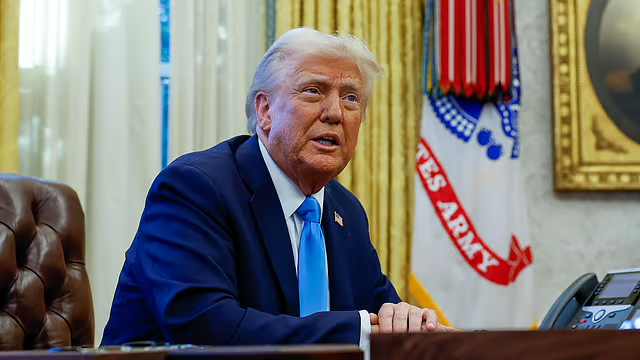
WASHINGTON D.C. — President Donald Trump on Monday signaled the possibility of imposing fresh tariffs on agricultural imports, specifically targeting Indian rice and Canadian fertilizer, following complaints from American farmers about cheap foreign goods undercutting the domestic market. Speaking at a White House roundtable where he announced a $12 billion federal aid package for the farming sector, the President vowed to “take care” of what he termed the “dumping” of Indian rice into the U.S.
The President’s remarks highlight escalating trade frictions, particularly in the agricultural sector, coming amidst ongoing and often difficult trade negotiations between the U.S. and India.
Farmers Decry ‘Dumping’ and Falling Prices
The issue was brought to the fore by representatives of the American farming community. Meryl Kennedy, who runs the Kennedy Rice Mill in Louisiana, told President Trump that rice producers in the southern U.S. were “really struggling” because other countries were “dumping” rice into the American market.
When pressed by the President to name the countries, Kennedy identified India, Thailand, and China (the latter specifically into Puerto Rico, once a significant market for U.S. rice).
“India, and Thailand; even China into Puerto Rico… We haven’t shipped rice into Puerto Rico in years,” Kennedy stated, noting that the issue had intensified recently. She added that while the administration’s current tariffs were helping, they needed to “double down” on protective measures.
Trump Suggests Tariffs as Quick Solution
President Trump responded strongly to the complaint, questioning why such practices were permitted and asserting that tariffs could solve the “problem” quickly.
“But they shouldn’t be dumping. I mean, I heard that. I heard that from others. They can’t do that,” Trump said.
He then turned to Treasury Secretary Scott Bessent: “India, tell me about India. Why is India allowed to do that? They have to pay tariffs. Do they have an exemption on rice?”
Bessent replied, “No sir, we’re still working on their trade deal.”
Reiterating his faith in punitive duties, the President insisted, “It’s solved so quickly with tariffs to these countries that are illegally shipping. It’s solved. Your problem is solved in one day.” He instructed his staff to note down the countries named. Kennedy also informed the President that there was an ongoing World Trade Organization (WTO) case concerning the issue with India.
Broader Trade Tensions
The new threat comes as the two nations are already grappling with trade disputes. Earlier this year, the U.S. had imposed a 50 percent tariff on a range of Indian goods, the highest rate globally, which included a 25 percent levy related to India’s purchases of Russian oil.
A U.S. delegation is scheduled to visit New Delhi this week for further talks on a Bilateral Trade Agreement (BTA), which aims to significantly increase trade volume. However, the President’s latest comments signal that a trade breakthrough, particularly on agricultural market access and tariffs, may remain distant.
Separately, the President also hinted at potential tariffs on Canadian fertilizer imports, arguing that similar trade actions were necessary to encourage and bolster domestic U.S. production across multiple sectors.
Indian Rice Exports
While India is the world’s largest producer and top exporter of rice globally, its share of the total U.S. market is relatively small. Data from the India Brand Equity Foundation (IBEF) shows that India exported approximately 2.34 lakh tonnes of rice to the U.S. in the 2024 fiscal year, which accounts for less than 5 percent of its total global basmati rice exports. The majority of Indian rice shipments go to West Asian nations.
The comments have already impacted Indian stock markets, with shares of major rice exporters experiencing a sharp decline on Tuesday morning amidst investor uncertainty over potential new tariffs.
The $12 Billion Farmer Bridge Assistance Program
President Trump’s administration announced the $12 billion aid package on Monday, December 8, 2025, during a White House roundtable with farmers. The package is designed to provide “bridge” funding to the American agricultural sector, which the administration claims has been hurt by market disruptions, elevated input costs, and unfair trade practices from foreign competitors.
Key Details of the Package:
-
Total Amount: $12 billion.
-
Funding Source: The administration stated that the aid will be bankrolled by the revenue collected from increased U.S. tariffs on foreign products.
-
Primary Program: Up to $11 billion is designated for the newly designed Farmer Bridge Assistance (FBA) Program, which provides one-time payments to row crop farmers.
-
Eligible Crops (FBA): The FBA is intended to cover row crops such as:
-
Rice
-
Soybeans
-
Corn
-
Cotton
-
Wheat
-
Sorghum
-
Barley, Peas, Lentils, etc.
-
-
Remaining Funds: The final $1 billion is reserved for specialty crops and other commodities (like sugar), with specific details and payment timelines still being developed by the USDA.
-
Eligibility Criteria:
-
Farmers with an average adjusted gross income below $900,000 for the 2022-2024 tax years are eligible.
-
Payments will be capped at $155,000 per farm or person.
-
-
Timeline: Farmers have until late December 2025 to submit acreage reporting data, and the aid is expected to be disbursed by the end of February 2026.
The administration framed this package as a necessary “bridge” to help farmers manage current financial difficulties—which they attribute to past administrations and foreign trade practices—until new, more favorable trade deals and market access take effect.