

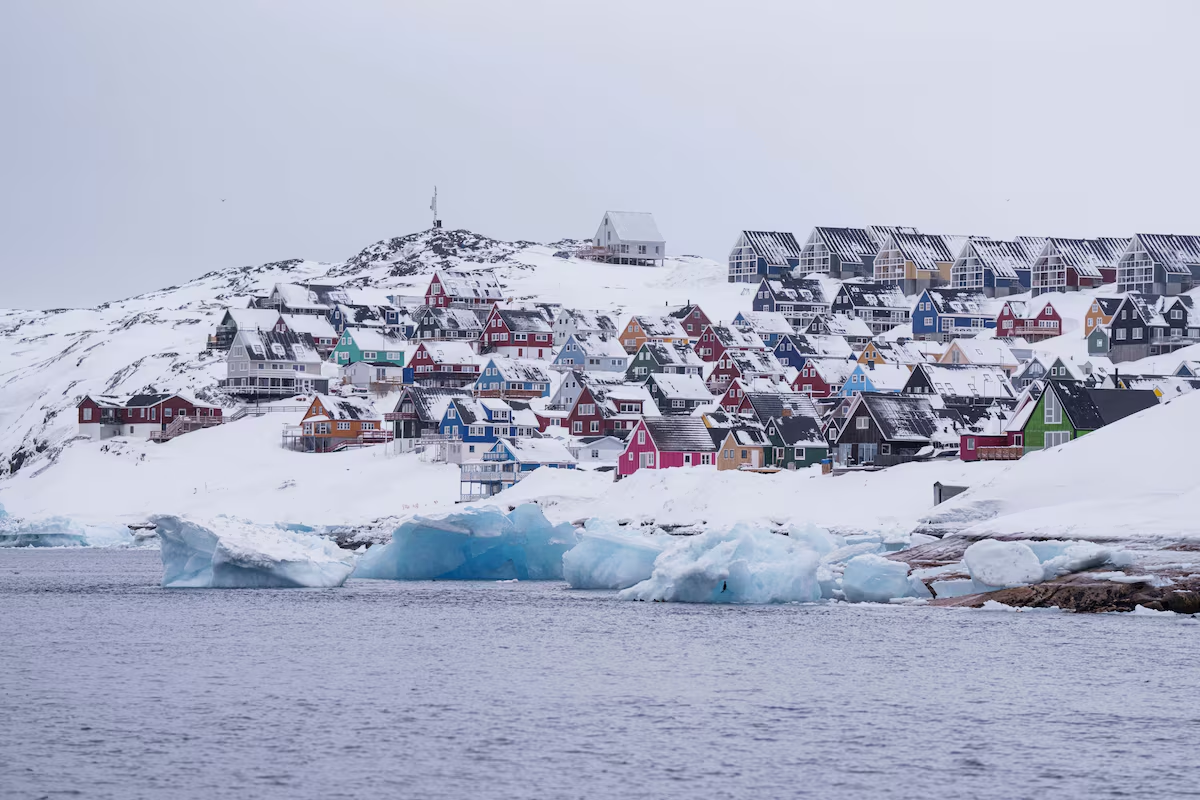
As of January 2026, the Arctic has shifted from a frozen frontier to the center of a global firestorm. President Donald Trump has reignited his ambition to acquire Greenland, the world’s largest island, framing it as a non-negotiable priority for U.S. National Security. While the White House describes the move as a strategic necessity to counter Russia and China, Denmark and the autonomous government in Nuuk have met the proposal with fierce resistance, warning that such a move could dismantle the NATO alliance.
Why the U.S. Wants Greenland: The Strategic Trio
The Trump administration’s interest in Greenland is driven by three primary factors: military positioning, resource dominance, and the race for new Arctic trade routes.
1. National Security and the “GIUK Gap”
Greenland occupies a critical geographic position between North America and Europe. For U.S. military planners, control over Greenland secures the GIUK Gap (the naval corridor between Greenland, Iceland, and the UK). This area is vital for monitoring Russian submarine activity and providing early warning systems against missile threats from Russia, China, or North Korea.
-
Pituffik Space Base: The U.S. already operates this key installation (formerly Thule Air Base) in northwest Greenland, which houses advanced radar for missile defense and space surveillance.
2. The Rare Earth Resource War
Beneath Greenland’s receding ice sheets lies a massive “trove” of critical minerals. As the world transitions to green energy and advanced technology, the demand for rare earth elements has skyrocketed.
-
Ending Chinese Dominance: China currently controls a near-monopoly on these minerals, which are essential for everything from iPhones to F-35 fighter jets.
-
Untapped Potential: Greenland holds 25 of the 34 minerals classified as “critical” by the European Commission, making it a potential powerhouse for Western economic independence.
3. The New “Polar Silk Road”
Climate change is melting Arctic ice at a record pace, opening the Northwest Passage. This new shipping route could slash travel times between Asia and Europe, bypassing the Suez Canal. Trump has argued that “economic security” requires the U.S. to prevent China from establishing a “Polar Silk Road” through these waters.
Greenland’s History: A Millennium Under the Danish Crown
To understand the current tension, one must look at the long and often complicated history between Denmark and Greenland.
From Colonization to Self-Rule
-
1721: Danish colonization began with the arrival of missionary Hans Egede.
-
1953: Greenland’s status changed from a colony to a formal province of Denmark.
-
1979 & 2009: Greenlanders voted for increasing degrees of Home Rule and later Self-Government. Today, Greenland is an autonomous territory within the Kingdom of Denmark. It manages its own domestic affairs, but Copenhagen retains control over foreign and defense policy.
A History of U.S. Offers
Trump is not the first American president to eye the island.
-
1867: The State Department first explored the idea of purchasing Greenland and Iceland.
-
1946: President Harry Truman offered Denmark $100 million in gold for the island after the U.S. occupied it during WWII to protect it from Nazi Germany. Denmark declined.
-
2019/2024: Trump revived the proposal, calling it a “large real estate deal.”
The 2026 Crisis: Can the U.S. Actually “Take” Greenland?
The current rhetoric has escalated beyond mere real estate talk. White House officials, including Deputy Chief of Staff Stephen Miller, have recently suggested that “all options are on the table,” leading to fears of a forced annexation or a “Venezuela-style” operation.

The NATO Breaking Point
Danish Prime Minister Mette Frederiksen has been clear: “Greenland is not for sale.” European leaders have warned that any attempt by the U.S. to seize a territory of a fellow NATO member would effectively end the alliance.
-
The “Compact of Free Association” Model: Some U.S. officials, including Vice President JD Vance, have hinted at a future where Greenland becomes independent from Denmark but enters into a “Compact of Free Association” with the U.S., similar to the arrangement with Palau or the Marshall Islands.
The Voice of the Greenlandic People
The 56,000 residents of Greenland, primarily Indigenous Inuit, have expressed anxiety over becoming “pawns” in a great-power struggle. While some pro-independence factions see U.S. investment as a path away from Danish subsidies, the majority insist on the right to self-determination.
Deployment Challenges for Google’s AI Center in Andhra Pradesh: A News Report
China Achieves Historic $1 Trillion Trade Surplus on Robust Global Diversification