
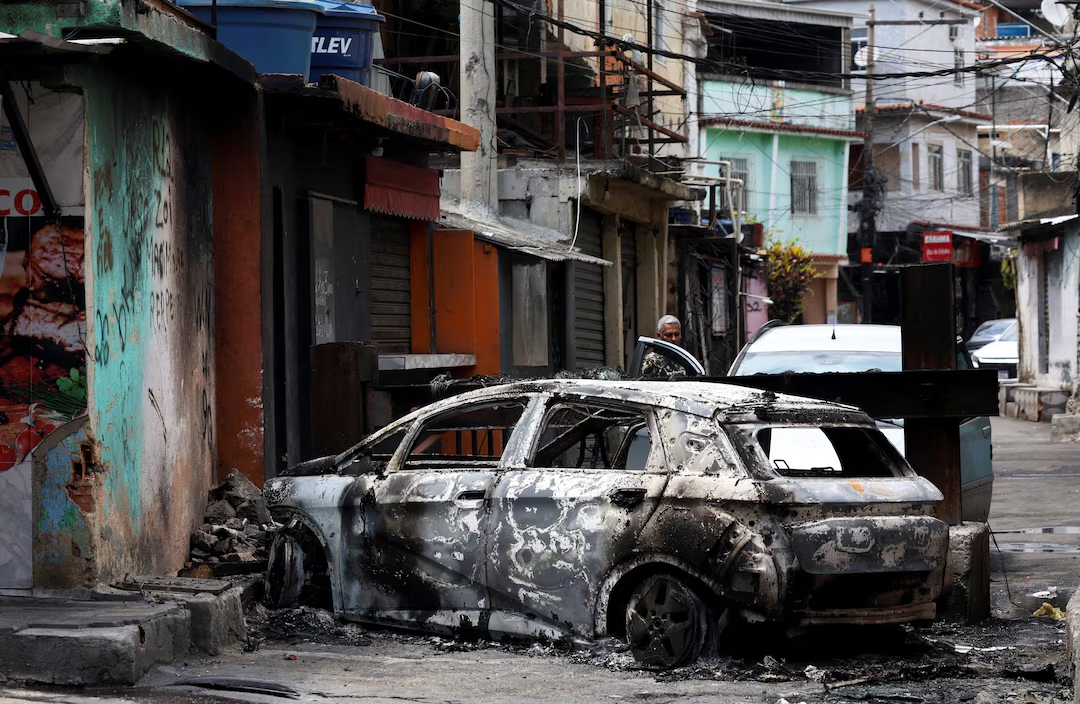
By Reuters Published: November 10, 2025
Thank you for reading this post, don't forget to subscribe!RIO DE JANEIRO — The governor of Rio de Janeiro hailed the deadliest police raid in Brazilian history as a success, but a Reuters review of the police report reveals a stark failure: none of the 117 people killed by police were among the 69 key suspects named by prosecutors as targets.
The raid, known as Operation Containment, left a total of 121 people dead, including four police officers and two teenagers, in two densely-populated working-class neighborhoods known as favelas. According to the police report shared with the Brazilian Supreme Court, only five of the charged individuals were arrested that day, and not a single one was a senior leader of the notorious Comando Vermelho gang—one of the largest and most violent in Brazil. The gang’s main leader, Edgar Alves de Andrade, known as Doca, remains at large.
The findings directly challenge the official narrative and have intensified criticism from human rights advocates and victim families who argue police killed indiscriminately instead of focusing on long-running investigations.
The Political Divide and Official Justification
The operation has become a flashpoint for political conflict, with leftist President Luiz Inacio Lula da Silva calling it disastrous, while conservative rivals, including Rio Governor Claudio Castro, champion aggressive raids as a necessary model to fight organized crime.
Rio’s public safety secretary, Victor dos Santos, who oversees the police, confirmed the initial goal was to arrest the men who had been charged. However, he maintained that the high death and arrest toll—with 99 suspects taken into custody—demonstrated that “the picture is a lot worse than what the investigation showed.” Despite 19 of the dead having no prior criminal record, Santos asserted he was “100 per cent certain” that they were all criminals.
“The police detain them, execute them and it’s all good, because they know there is no law here.”
The sheer brutality of the raid has fueled outrage. Samuel Peçanha, whose 14-year-old son Michel was killed, captured the sentiment of the community. He said the police “detain them, execute them and it’s all good, because they know there is no law here,” adding, “In Brazil, that’s normal.” Though his son was part of the gang, Peçanha lamented, “He was still a child… Unfortunately, I wasn’t able to get him out.”
‘I just want this to end’
The aftermath saw mothers and residents venturing into the forested hills to retrieve bodies. Taua Brito, 36, described finding her 20-year-old son, Wellington, who was a member of the local gang. She hiked into the woods overnight and found him at around 1:30 a.m.
“I must have seen some 50 bodies,” she said. Wellington, she said, was shot in the head and stabbed in the arm. In one of his last messages to her, he said he planned to clear his name: “I just want this all to end already.”
Residents later lined up dozens of the dead bodies in a busy street, where the community shops and children play soccer.
Gruesome Injuries Fuel Controversy
Public records and video reviewed by Reuters show the body of 19-year-old Yago Ravel was headless. Other bodies were reported to have stab wounds.
Public safety secretary Santos suggested these gruesome injuries were likely inflicted by members of the gang themselves “to create this barbaric scene,” claiming preliminary analysis showed the decapitated man was already dead when his head was cut off. Santos also stated that residents had compromised the crime scene, making a full investigation difficult.
Beatriz Nolasco, Yago Ravel’s aunt, expressed a lack of faith in justice: “We will never be able to accept how he was killed, with his head torn off and placed on a tree.”
The operation, which involved 2,500 police officers, was defended by Santos as a show that “the state holds the monopoly on the use of force.” However, public defender Pedro Carriello, who is assisting the families, argued that such raids do not end the decades-long gang violence, saying, “For a moment, you disassemble an armed group… but it doesn’t end. What remains are the losses of the families.”
While a nationwide survey by AtlasIntel showed 55 per cent of Brazilians backed the police operation, the families of the victims remained focused on accountability. As Wellington’s mother summarized: “The police had the right to arrest my son… But not to kill him.” In 2024, Brazil recorded 6,243 people killed by police, averaging 17 deaths per day.