

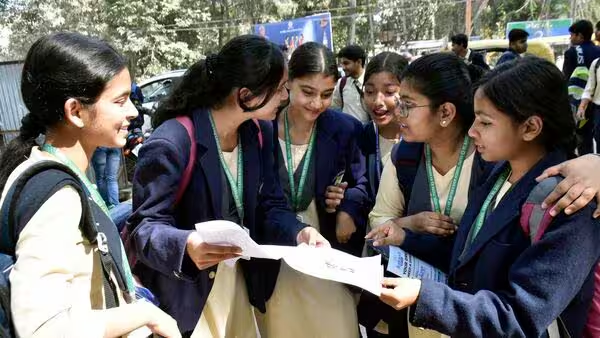
NEW DELHI | February 17, 2026 — The Central Board of Secondary Education (CBSE) has officially kicked off the 2026 board examination season today, February 17, 2026. This year marks a historic shift in the Indian education landscape, as the board implements groundbreaking reforms aligned with the National Education Policy (NEP) 2020.
From a revolutionary two-exam system for Class 10 to a heavy emphasis on critical thinking, these changes aim to dismantle the “high-stakes” pressure of single-day performance. Here is your definitive guide to the new CBSE 2026 exam paradigm.
1. The Two-Exam System: A Safety Net for Class 10
For the first time, Class 10 students are no longer bound by a “do-or-die” final test. The board has introduced a dual-examination window within the same academic year to reduce student anxiety.
-
First (Main) Examination: Mandatory for all. Running from February 17 to March 11, 2026.
-
Second (Improvement) Examination: Optional. Scheduled from May 15 to June 1, 2026.
-
Best of Two: Students can choose to appear in up to three subjects during the second phase. The final marksheet will reflect the higher score between the two attempts.
Important Note: The first exam is compulsory. Students cannot skip the February session and jump straight to the May improvement attempt.
2. Shift to 50% Competency-Based Questions
Rote memorization is officially out. For both Class 10 and 12, question papers have been redesigned to test real-world application and analytical skills.
| Question Type | Weightage | Description |
| Competency-Focused | 50% | Case studies, source-based analysis, and data interpretation. |
| Objective/MCQs | 20% | Multiple-choice and assertion-reason questions. |
| Descriptive | 30% | Short and long-form answers focusing on clarity and logic. |
3. Strict Rules for Answer Booklets
In subjects like Class 10 Science and Social Science, CBSE has introduced section-specific answer booklets. Students must ensure they write Physics, Chemistry, and Biology answers in their designated sections. Mixing sections may lead to non-evaluation, even if the content is correct.
4. Mandatory 75% Attendance & APAAR ID
The board is reinforcing discipline with two critical administrative requirements:
-
Attendance: A minimum of 75% attendance is compulsory for eligibility. Schools are under strict orders to report shortfalls accurately; calculated as of January 1, 2026.
-
APAAR ID: Every student must be registered with an APAAR ID via the Pariksha Sangam portal, serving as a permanent digital academic ID for tracking progress.
5. Key Dates & Results
The results for the first phase are expected by early April 2026, allowing students to take provisional admission into Class 11. The final consolidated results, including those who took the second attempt, will be released by June 2026.
PM Modi Unveils Skyroot Infinity Campus, Boosts Space Investment
Kremlin Confirms: Putin Receives Formal U.S. Invitation to Join ‘Board of Peace’ for Gaza