
New Delhi, India — Wednesday, November 12, 2025
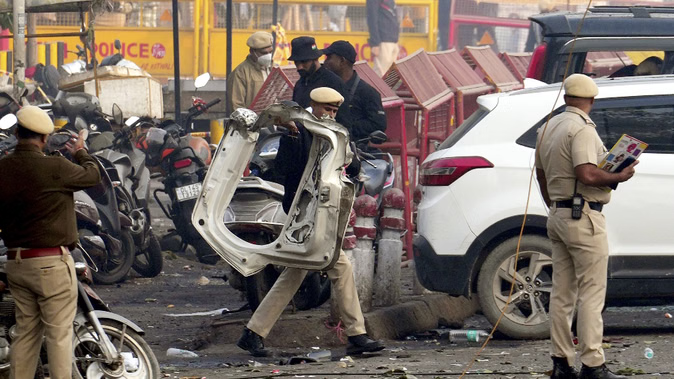
Thank you for reading this post, don't forget to subscribe!The deadly car bombing near Delhi’s Red Fort, which claimed 13 lives, was not an isolated incident but the desperate, premature act of a bomber on the run. The National Investigation Agency (NIA) and counter-terrorism forces have revealed how a sprawling “white-collar” terror network of educated professionals was meticulously exposed, beginning with a seemingly minor act of public provocation in Kashmir.
The investigation, spanning Jammu & Kashmir, Haryana, and Uttar Pradesh, is a textbook case of forensic and human intelligence collaboration, dismantling a plot that could have led to a catastrophic series of attacks across the hinterland.
Layer 1: The Initial Thread – Jaish Posters in Kashmir
The entire counter-terror operation was triggered by an innocuous but strategically important piece of evidence: posters of the Pakistan-based Jaish-e-Mohammed (JeM) that appeared in Srinagar’s Bunpora Nowgam area on October 19, 2025.
- Curiosity Pays Off: While such posters were common years ago, their sudden re-appearance fuelled the curiosity of Srinagar’s Senior Superintendent of Police (SSP), G. V. Sundeep Chakravarthy, who insisted on tracking their origin.
- The Pawns Revealed: CCTV footage and local intelligence led police to three overground workers (OGWs)—individuals with a history of stone-pelting—who were responsible for putting up the posters. Their subsequent interrogation led to the first major breakthrough: the identity of their radicalizer.
Layer 2: The Radicalizer and The Cleric’s Conveyance
The interrogation of the OGWs led police to the individual responsible for their radicalisation and coordination with the wider network.
- The Cleric’s Role: Police successfully traced a key figure: Maulvi Irfan Ahmad, a religious scholar from Shopian, J&K. Maulvi Irfan, along with his aide Zameer Ahmad Ahanger, was found to be instrumental in radicalising the local youth and linking them to terror outfits like JeM and Ansar Ghazwat-ul-Hind (AGuH).
- The Conveyance to Muzammil: It was through the interrogation of Maulvi Irfan Ahmad and Zameer Ahanger that the police reached Dr. Muzammil Ahmad Ganaie, the individual who held the operational key to the plot outside Kashmir. The cleric conveyed key information about the module’s logistics, leading investigators to Faridabad, Haryana.
Layer 3: Unmasking the ‘Doctors of Doom’ in Faridabad
The trail led police to Al-Falah University in Faridabad’s Dhauj area, where the terror module had successfully embedded itself using the cover of academic and medical professions.
- The Key Arrests: Dr. Muzammil Ahmad Ganaie, an Assistant Professor at the University, was arrested on October 30. His questioning, and that of Dr. Adeel Ahmad Rather (arrested in Saharanpur, UP), revealed the true scale of the conspiracy.
- The Massive Haul: Based on Dr. Muzammil’s disclosures, a joint operation recovered a staggering 2,900 kg of IED-making material, including 358 kg of highly suspected Ammonium Nitrate, two AK-series assault rifles, a Krinkov, pistols, detonators, and timers, stored in rented houses near the university. The quantity and sophistication of the cache pointed towards a massive, coordinated attack plan targeting major Indian cities.
- The Women’s Wing: Further interrogation of the network led to the arrest of Dr. Shaheen Sayeed from UP, who was allegedly tasked with setting up the “Jamaat-ul-Mominat,” a women’s recruitment wing for JeM, highlighting the depth of the radicalisation effort.
Layer 4: The Final Act – Panic and Premature Detonation
The widespread arrests and the massive seizure of explosives placed Dr. Umar Nabi Bhat, also an Assistant Professor at Al-Falah University and the suspected mastermind of the module, under immense pressure.
- The Bomber on the Run: Investigators believe Dr. Umar Nabi, who was the driver of the Hyundai i20 that exploded near the Red Fort, was on the run after his associates were busted.
- The Panic Attack: Forensic and investigative findings suggest the explosion on Monday evening was “premature” and accidental, triggered in a state of panic rather than being a planned fidayeen (suicide) attack. The car was still moving, no shrapnel was recovered, and no crater was formed—all indicators of a hastily assembled and prematurely detonated device.
- DNA Confirmation: DNA samples taken from Dr. Umar Nabi’s mother are now showing a high likelihood of matching the remains from the car, confirming that the initial thread—the JeM posters—led police all the way to the terror plot’s end, preventing a much larger disaster.
The NIA continues to probe the financial and logistical chains of the network, with focus on tracing phone records to Pakistani handlers and understanding how the educated professionals were radicalised and recruited into this deadly operation.